Enter a search phrase
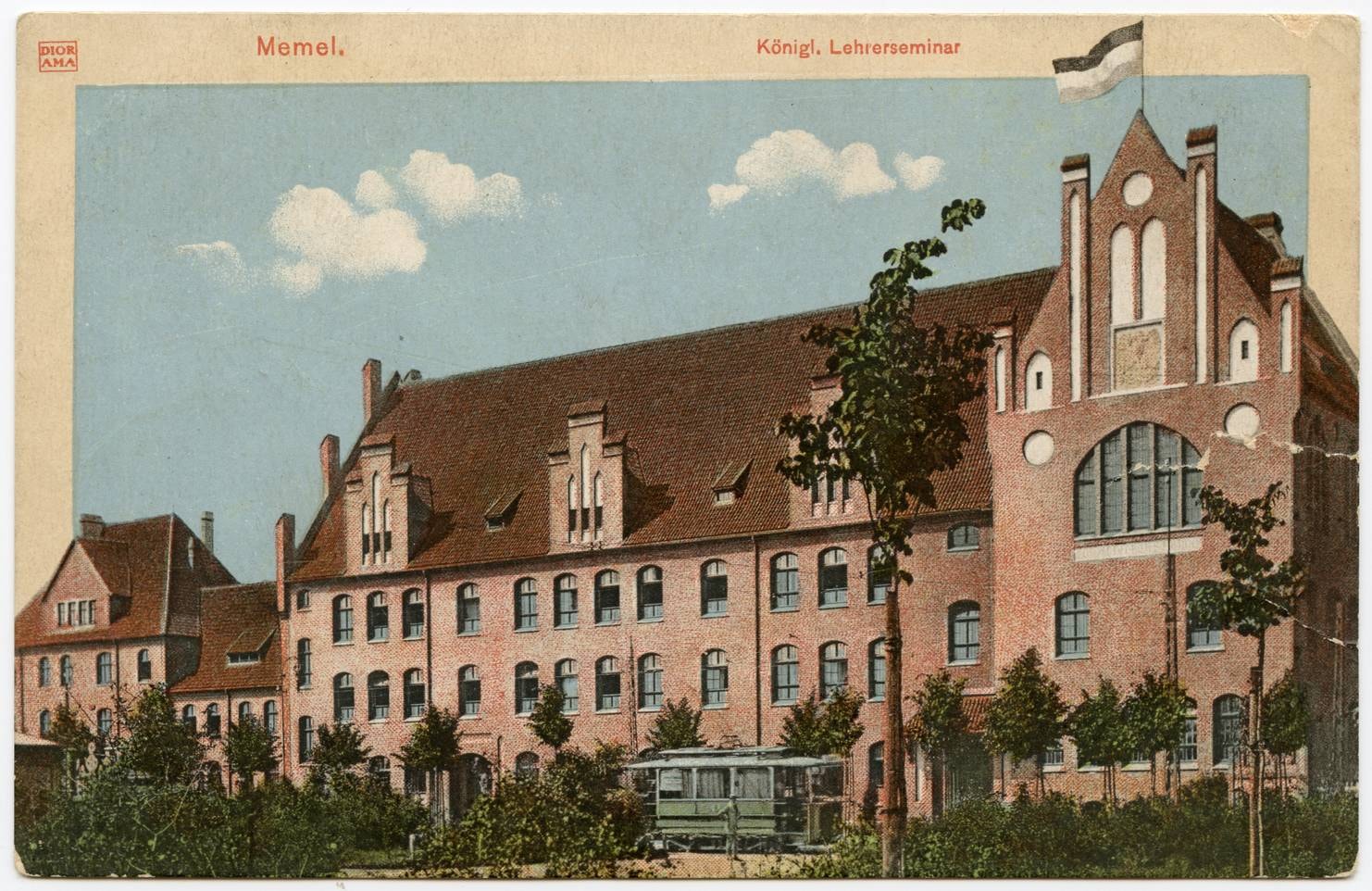
Royal Teachers Seminary
Coordinates: 55.719612 21.134343
Object address: S. Nėries gatvė 5, Klaipėda, Lietuva
Municipality: Klaipėda
The red brick Royal Teachers’ Seminary (Königliches Lehrerseminar) was built in 1908 near the railway station at then Bahnhofstrasse, now 5 S. Nėries St. The complex consists of four buildings. The building of educational facilities with an impressive auditorium is a massive three-story building. It stands out from the others with its massive Gothic pediments. The two-story and three-story buildings had living premises. One has apartments for teachers; the other was a dormitory for seminarians. The auxiliary building had a canteen, a kitchen, a gymnasium, a library, and other premises. The seminary had its own vegetable garden, a garden and a sports field. It was the most modern seminary in Prussia at the time, with highly qualified pedagogues.
In 1915, the activity of the seminary was temporarily interrupted due to the outbreak of World War I. 89 percent of the seminarians were drafted into the army, and the remaining 10 percent were distributed to other seminaries.
During World War I the complex was turned into a hospital. After the war, the studies were renewed and the construction administration, the social welfare board, and the Klaipėda regional police operated in the building. In 1919, the seminary began to function in a normal mode. In 1922-1933 it was a Lithuanian high school; in 1934, it became the German Pedagogical Institute of Klaipėda Region, which was reformed into the Lithuanian Pedagogical Institute in 1935. In 1932, a decision was made to extend the education at the seminary to four years. The seminary was closed, when in 1936 the Government decided that primary school teachers had to be trained in pedagogical institutes. Women could also study at the seminary. It was mandatory for everyone to know the Lithuanian language at a certain level. In the last year of activity (autumn 1935), the seminary had 75 students and 8 teachers.
In 1943-1944, a School of Pedagogy was here. At the end of 1944, it housed the military headquarters, and after World War II, various educational institutions worked in the building: primary schools, gymnasiums, teachers’ seminary, and pedagogical schools. Since 1975, it became the Faculty of Preschool Education of Šiauliai Kazys Preikšas Pedagogical Institute. In 1991, the building was handed over to the established Klaipėda University.
In 2016, the renovation of the building’s facade, which took almost a decade, was completed by ‘Pamario restauratorius’.
Commemorative plaques are fixed on the facade of the building: in 1995 – to mark the 60th anniversary of the founding of Klaipėda Pedagogical Institute, in 2008 – in memory of the institutions that operated in the building, in 2017 – to Martin Krukis (1884–1948), who headed the Klaipėda Lithuanian Gymnasium and the State Teachers’ Seminary that operated in the building; in 2019 – to Adolfas Ramanauskas-Vanagas (1918–1957), the commander of the Lithuanian partisan resistance, who studied here in 1937–1939.
An object on the route "Literary Klaipėda between the wars"
Erich Karschies, Bruno Le Coutre, Jonas Užpurvis, Rudolf Naujoks, and Ewaldas Swars studied in this building, and later appeared as writers and/or as school directors.
Pranas Mašiotas (born in 1863 in Pūstelninkai, Būbleliai rural district, Šakiai county, died in 1940 in Kaunas) in 1922-1933 was the headmaster of the Lithuanian high school, which operated in the building from 1924 to 1929. P. Mašiotas was a prominent Lithuanian pedagogue, children’s writer, publicist, translator, textbook author, public and cultural figure. In 1883, he finished Marijampolė Gymnasium, in 1887 graduated from Moscow University, where he obtained a high school mathematics teacher’s specialty at the Faculty of Physics and Mathematics. He belonged to Lithuanian student and pharmacist associations at the university. After graduating, he did not get a job in Lithuania, so worked as an official in Łomża (Poland). In 1889, he was invited to Riga by the linguist Jonas Jablonskis. Mašiotas was a teacher of mathematics at Riga City German Real School, the Headmaster of Riga Girls’ Gymnasium. He got married in Riga and had three children. In 1915, he retreated to Moscow, and in 1915-1918 was the Headmaster of Lithuanian high school in Voronezh. In 1918, he returned to Lithuania and in 1919-1923 was the Lithuanian Deputy Minister of Education.
- Mašiotas arrived in Klaipėda in 1924 and in 1924-1929 he was the Headmaster of Klaipėda Vytautas the Great Gymnasium. In 1929, he retired and devoted himself to literary work. In 1938-1940, he lived and created in the house of his son Jonas Mašiotas in Kačerginė.
- Mašiotas started collaborating in the press since 1888 in the ‘Aušra’ and he was involved in publicistic writing almost until the end of his life. He contributed to about 50 publications. He wrote mostly about education and culture of the nation and society; published articles on journalism theory. His journalism is restrained, matter-of-fact, with specific proposals, focused more on the mind and intellect of the reader. He left more than 500 journalistic essays. P. Mašiotas signed his works either with his surname or pseudonyms.
- Mašiotas is the author of about 150 books: including 8 textbooks (mathematics, physics, spelling), 30 books – fiction for children (‘Fairy tales’, ‘Plant tales’, ‘When the books were banned’, ‘Old man’s tales’, ‘Hares’). He translated about 60 books from foreign languages, including J. ‘Gulliver’s Travels’ by Swift, ‘Robinson Crusoe’ by D. Defoe, ‘The First Men on the Moon’ by H. Wells, etc.
Two of his books were published in Klaipėda, at the ‘Rytas’ printing house: ‘Seasides by sea: children’s journeys around our seashore: with 22 pictures and a map’ (1930), ‘Būta ir pramanyta’ (1925)
His commemoration in Klaipėda: a pro-gymnasium named after him.
Ewald Michael Swars (born in 1890 in Rubokai, Šilokarčema county; died in 1962 in Frankfurt am Main, Germany). He lost his parents at the age of nine, attended Verdaine folk school for eight years, then continued his studies at Klaipėda preparatory school in 1905, and in 1908 he became a student of Klaipėda Royal Teachers’ Seminary. The inner world of the writer was focused, disciplined, so he was different from his peers. His first book of poetry ‘Sehnsucht’ appeared while he was still in seminary. However, this book went unnoticed (in 1921, he bought the remaining copies from the publisher and burned them). During his teaching practice in Nemirseta, he did not get along with the village community. In 1913, signed up as a volunteer for military service, and served in Klaipėda.
He was wounded in August of 1914, was captured by the Russians and remained in Siberia until 1920. After being released, he returned to Klaipėda. The experiences in the captivity are revealed in his works – short stories and expressionist poems. After Klaipėda region was annexed to Lithuania, he did not stay here. He wrote articles, short stories, poems, which were also printed by the ‘Memeler Dampfboot’. The heroes of his books are farmers and fishermen. In 1939, the book ‘Jonuschat,s Weg in die Einsamkeit’), in 1942 – ‘Das Dorf am Mee’r, and in 1943 – a powerful autobiographical novel about trying to adjust after returning from Siberia, ‘ Das heilige Ufer’ (‘The Holy Shore’) were published.
The short stories ‘Manner in Ketten’ (‘Men in Chains’) are his best works. This is a story about the years of captivity in Siberia, about the young soldier Ernst, whom we meet at the beginning of the novel, later during the camp prisoners’ strike. He is a shy young man who cannot deal with psychological problems.
Bruno le Coutre (1889–1972) was born and raised in Klaipėda, finished Old Town Boys High School and later graduated from Klaipėda Seminary. He was an educator and a public figure. Bruno le Coutre worked at Bomelsvitė school for 21 years, and was its Headmaster for 17 years. After being blown to Germany by the winds of war fate, he managed the public library in Praetz, was a member of the city council, and was awarded the Order of Merit of the Federal Republic of Germany with a ribbon.
B. le Coutre started writing memoirs about Klaipėda while living in Germany. They were printed between 1953 and 1973 in the newspaper ‘Memeler Dambfboot’ and the publication ‘Memelland Kalender’. They were collected in a book in 2014 and published under the title ‘My city Klaipėda in 1930–1939’ by the Lithuanian Maritime Museum (translated by Romualdas Adomavičius). The book publishes memoirs about Klaipėda: the port, streets, suburbs and active life in them; the pastimes and concerns of townspeople from various social groups. The author wittily talks about the oddities of the city, describes almost all the shops, pubs, hotels and their owners. A lot of space is dedicated to the fishermen and sailors village of Bomelsvitė, close to Klaipėda, where people spoke German, Lithuanian and Curonian.
Sound recording
Nėra pavadinimo / Tekstą skaitė Agnė Jonkutė. ,
Provider: Ieva Simonaitytė Public Library of Klaipėda County
Format: mp3
Nėra pavadinimo / Tekstą skaitė Agnė Jonkutė. ,
Provider: Ieva Simonaitytė Public Library of Klaipėda County
Format: mp3